

APDA APDA Chair-IPPF New Director General Dialogue: Reframing Global Health in an Era of Geopolitical Tension
1 April 2026, Online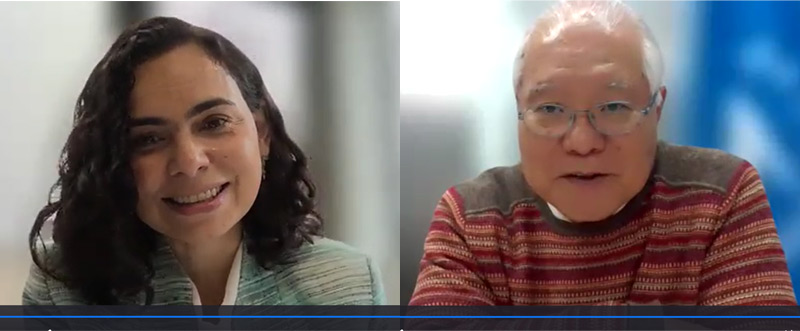
The International Planned Parenthood Federation (IPPF), which has been a partner organization of the Japan Parliamentarians Federation for Population (JPFP) for over 50 years, appointed Ms. Maria Antonieta Alcalde Castro as its new Director-General in April. As geopolitical tensions intensify and both development assistance and global health financing come under strain, the need to build sustainable and resilient health systems has become increasingly urgent. Against this backdrop, Ms. Alcalde Castro held an online dialogue with Prof. Keizo Takemi, former Minister of Health, Labour and Welfare and Chair of the Asian Population and Development Association (APDA; JPFP Secretariat), exchanging views on the end of the “golden age” of health financing, challenges surrounding sexual and reproductive health and rights (SRHR), and the role of universal health coverage (UHC) and international cooperation. (Moderator: Fukuda Tomoko, Regional Director of East, Southeast Asia and Oceania Region of IPPF)
Professor Takemi Keizo: First of all, let me warmly congratulate you on taking up your new role.
Ms. Maria Antonieta Alcalde Castro: Since we worked together as members of the High-Level Task Force for ICPD, I am very pleased to have the opportunity to collaborate with you again.
Moderator: First question goes to Professor Takemi. How do you see the current global situation and its impact on global health?
Professor Takemi: During the Millennium Development Goals (MDGs) era, global health financing expanded significantly, as three of the eight goals were health related. With the SDGs, however, resources became dispersed across 169 goals, creating intense competition across sectors such as poverty reduction, climate change, and environmental issues. As a result, the “golden age” of health financing came to an end. A second wave of challenges has emerged from geopolitical tensions: the war between Russia and Ukraine, the conflict in Gaza, and shifts in U.S. policy that have reduced multilateral commitments in favor of bilateral approaches. These developments have led to a sharp decline in health financing from many advanced economies. Rising instability involving Iran, the United States, and Israel further threatens both financing and global health governance. In this context, it is essential to strengthen domestic resource mobilization in low- and middle-income countries while also reinforcing global health governance. Japan, through the UHC Knowledge Hub in Tokyo, plays an important role in supporting countries in expanding fiscal space for health. A dual strategy is required: responding to geopolitical pressures while strengthening national ownership and resilience.
Moderator: Ms. Alcalde Castro, how has this affected IPPF as a global federation?
Ms. Alcalde Castro: The current environment is extremely challenging for SRHR. IPPF has long prepared for shifts in U.S. policy, but the present situation is completely different. Recent bilateral agreements led by the US include provisions that restrict countries’ sovereignty and their ability to provide SRH services. This poses a serious threat not only to SRHR but also to the broader development assistance architecture. Last year, IPPF surveyed 81 Member Associations, many of which are now facing severe funding cuts (approximately US$87 million) in contracts originally planned for 2025 to 2029. The impact extends beyond IPPF’s direct funding; reductions, for example, mean that contraceptive supplies and other essential commodities may not reach those who need them most. In response, we launched the Fightback Fund. So far, we we’ve already disbursed over $6.6 million to 36 Member Associations to maintain lifesaving SRH services in the countries most affected by U.S. funding cuts and policy shifts, most of which are in Africa.
Professor Takemi: IPPF’s proactive response is vital. As global financing continues to contract, countries must also strengthen their domestic resource mobilization. International partners should support national ownership and help build resilient systems.
Moderator: Why is UHC important in the process of reframing the global system?
Professor Takemi: UHC encourages countries to build sustainable health systems and mobilize domestic resources. International cooperation should reinforce these efforts by promoting good governance, transparency, and long term system strengthening.
Moderator: Ms. Alcalde Castro, how does IPPF respond at the national level, and how is the IPPF Secretariat transforming its organization and operations?
Ms. Alcalde Castro: We are supporting Member Associations in engaging with governments, parliamentarians, and multilateral organizations. We develop policy briefs, guidelines, and training to enhance advocacy capacity and local resource mobilization. We prioritize countries based on their vulnerability to funding cuts, unmet SRHR needs, and opportunities for policy impact. In restrictive environments, we pursue evidence based activities while supporting local NGOs to ensure communities remain supported. Capacity building is central—strengthening governance, sustainability, and service innovation so that Member Associations remain resilient amid political and financial uncertainty.
Moderator: Professor Takemi, how should Japan contribute to building a new global health system?
Professor Takemi: Coordination among multilateral organizations, governments, and civil society is essential. Avoiding duplication and leveraging the comparative strengths of each actor will be key. Countries must also enhance domestic governance and resource mobilization to sustain programs even when external support fluctuates. Japan, through initiatives such as the Tokyo UHC Knowledge Hub, can play a significant role in supporting rebuild resilient global health systems and local leadership and serve as a foundation of the global health architecture. At the national level, it is essential for ministries of finance and health to work in close coordination, while at the international level, experts and institutions in both finance and health must collaborate closely to advance its work. In this regard, the fact that the Hub is operated through the collaboration of two leading institutions representing health and finance, namely the WHO and the World Bank, carries significant meaning, as it contributes to a sustainable new global health architecture. It will serve as a leading example of re-designing systems beyond national boundaries.
Ms. Alcalde Castro: Collaboration with Japan is essential and more important than ever to advancing our common goals and amplifying our global impact. These goals include expanding access to SRH services, advocating for reproductive rights, strengthening Member Associations, ensuring sustainability, and investing in innovations such as digital health and telemedicine.
Professor Takemi: I will continue to work to ensure that IPPF is widely recognized not only as an SRHR service provider, but also as an organization that advances human rights and as Chair of APDA, I will act as a catalyst for the Japan-IPPF partnership.
Moderator: Thank you both for your insights.